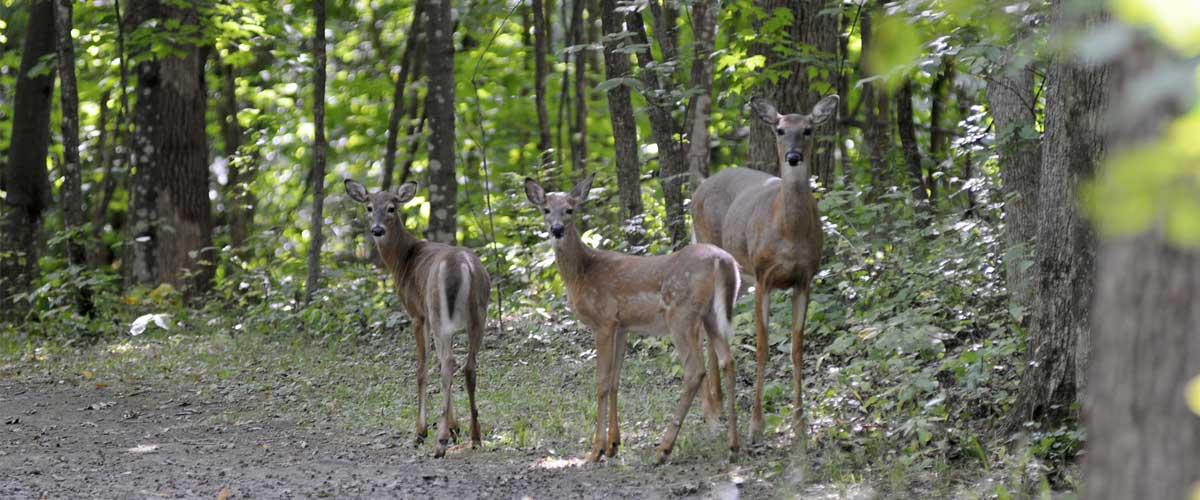
Three Rivers Park District is continuing a partnership with the University of Minnesota on a research project to study white-tailed deer in the Twin Cities region.
The project will study the habitat use and movement of deer in and around the parks. The effort will also provide insight into the prevalence of diseases among the deer population that can affect both deer and humans, including chronic wasting disease (CWD), Lyme disease, SARS-CoV-2 (COVID-19 in humans) and tick-borne pathogens.
The study continues work that took place in previous years at Elm Creek and Carver Park Reserves. Additionally, this year deer will also be studied at Hyland and Murphy-Hanrehan Park Reserves. At Murphy-Hanrehan, deer will be temporarily sedated so biological samples can be taken and a GPS tracking collar can be placed on each deer. The collar will record the location of the deer every 30 minutes. This will allow researchers to monitor deer movements throughout the area.
At Murphy-Hanrehan, on days when the work is taking place, a low-flying helicopter may be seen in and around the park. Work is expected to take place throughout March, depending on weather conditions. How deer utilize the urban-suburban landscape is an understudied area of research that has important implications for deer management, including the reduction of negative human-deer interactions.
Three Rivers Park District Natural Resources staff will use the information gathered by the study to refine the Park District’s deer management program. Funding for the project was provided by the U.S. Department of Agriculture and the Minnesota Environment and Natural Resources Trust Fund as recommended by the Legislative-Citizen Commission on Minnesota Resources (LCCMR).
For more information, contact Steven Hogg at Three Rivers Park District, (763) 694-7848.